
Tree Removal in Avalon Beach
A cocos shedding fronds into your pool, a Norfolk Island pine over your roof, a spotted gum on a block that drops toward the water. Whichever one it is, we take it down across Avalon Beach, Clareville and Palm Beach.
- Suburbs
- Avalon Beach 2107, Clareville 2107, Palm Beach 2108
- Block
- Beachside, steep to the water
- Trees
- Cocos and other palms, Norfolk Island pines, spotted gums
- Quote
- Free
Cocos palms and big gums on the peninsula
Older Avalon gardens hold plenty of introduced palms, the cocos among them. It seeds into bush and creek banks, and it harms flying-foxes, whose wings catch in its flower sheaths and leaves.
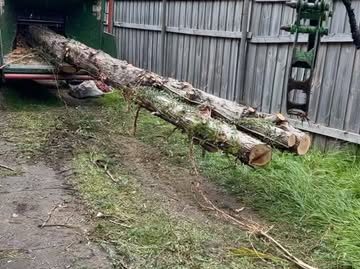
A cocos comes down cleanly. Our climber takes its fronds first, then cuts its trunk in short lengths, and a cocos cut below its lowest leaf never regrows.
We clear fallen fruit too, so seedlings don't pop up all over your garden. And that's the end of fishing fronds out of your pool.
Big natives are a bigger job. Spotted gums and angophoras grow tall over blocks that fall away to the ocean or Pittwater, and roads up here are narrow.
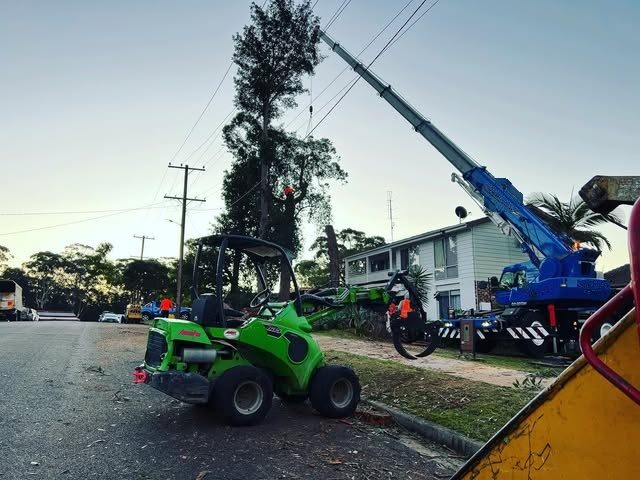
Here at Arbor Corp Tree Services we work those crowns down in sections on ropes. On the tallest trees we bring in a crane to lift pieces over your house to our truck.
Palms, pines and salt wind on your steep block
Avalon Beach is the beachside lot at its steepest, with palms and Norfolk Island pines in salt wind, sandy soil, and access that drops away toward the water.
Beachside block? Send us the whole palm or tree, your pool or roof beneath it, and the path down the side.
Heritage palms, protected gums and storms up this end
Palm Beach takes its name from the cabbage tree palms that grew near Cabbage Tree Boat Harbour.
Several of its heritage-listed trees are palms and gums. There are cabbage tree palms and Sydney red gums near Pacific Road, spotted gums and cabbage tree palms near Florida Road and Ocean Road, and Norfolk Island pines near Ocean Road and Barrenjoey Road.
Between Avalon Beach and Clareville, the Wildlife Preservation Society bought Angophora Reserve in 1937 to protect one giant angophora, and it opened in March 1938.
Pittwater and Wagstaffe Spotted Gum Forest, an endangered community, grows on this peninsula, mostly in small remnants on private land. The Ruskin Rowe estate is heritage-listed partly for keeping its bushland setting.
Storms find this end of the Beaches. In April 2015's east coast storm, winds of 100-125 km/h brought trees down at Ruskin Rowe and on Bellevue Avenue.
After a weekend storm in February 2017, Avalon, Clareville, Whale Beach and Palm Beach were among the worst-hit areas, and council ran an extra green waste collection from Avalon to Palm Beach.
What grows up the peninsula
- Heritage trees
- Cabbage tree palms, spotted gums and Norfolk Island pines near Palm Beach roads
- Protected forest
- Spotted gum remnants on private lots
- Common trees
- Cocos and other introduced palms, angophoras, spotted gums
- Ground
- Steep headlands and ridges, ocean on one side and Pittwater on the other
Which Avalon palms can go without a permit
Palms are the easy part. Council's exempt list covers every palm except the native cabbage tree palm, and it names the cocos outright.
So your cocos or Canary Island date palm can come out without a permit, while a cabbage tree palm over 5 m needs one.
That exemption stops at heritage land. On a heritage item or in a heritage conservation area, every tree needs a permit, palms included.
In July 2020 council warned of rogue tree operators in the Avalon area offering cheap removal of large trees without permission, which leaves an owner open to fines. That's why your permit or exemption gets settled before our first cut.
Already hold an approval, or have an exemption in mind? Send it through with your photos.
Sorting out which palm is which
- Want the cocos gone but the cabbage tree palm kept? Say so, and point out which palm is which in your photos.
- Look your address up in council's property search, under Planning Rules, for a heritage listing before you plan palm removal.
- Spotted gums on your block? On land shown on the NSW Biodiversity Values Map, a living native can need the Native Vegetation Panel's approval instead of council's.
We’re next door in Newport and Church Point too. See every suburb
Cocos, cabbage palms and spotted gums
Can you take out the cocos palms but leave the cabbage tree palms?
Yes. Off heritage land your cocos are exempt and can come out without a permit, while a cabbage tree palm over 5 m needs one. We take only the palms you mark, lowering each in pieces clear of the ones you keep.
Is my spotted gum part of the protected forest?
Spotted gum forest grows across the peninsula in small patches on private lots. Check your address on the NSW Biodiversity Values Map and in council's property search, then send us photos of your tree.
How do you get gear down a steep Avalon driveway?
Our chipper stays up on the road, and our climber lowers sections down the slope on ropes. Where our loader can't reach, a crane lifts pieces up and over to the truck.
We'd like the Norfolk pine over the roof gone. What's needed?
Over 5 m, a council permit, because Norfolk Island pines aren't on the exempt list, though nearly every palm is. With your permit in hand, we take the pine down tier by tier, and the quote is free.
Send us your palms and gums
A few photos from the ground, with your roof, pool or fence in the shot, and we can price it properly.
Got it, thanks.
We’ll ring you back about the tree and your free quote. To talk sooner, call 1300 911 620.
Good things to send
- Your suburb
- A few photos showing all of your tree and what’s under it
- Beachside, plateau or bush edge
- How we get in from the street
- Your council permit or written OK, if you have one
Then what?
- We ring you back and talk through your tree and the way in.
- You get a free quote for the whole job, chipping included, plus the stump if you want it gone.
- We book a day and bring a crane too if your tree calls for one.